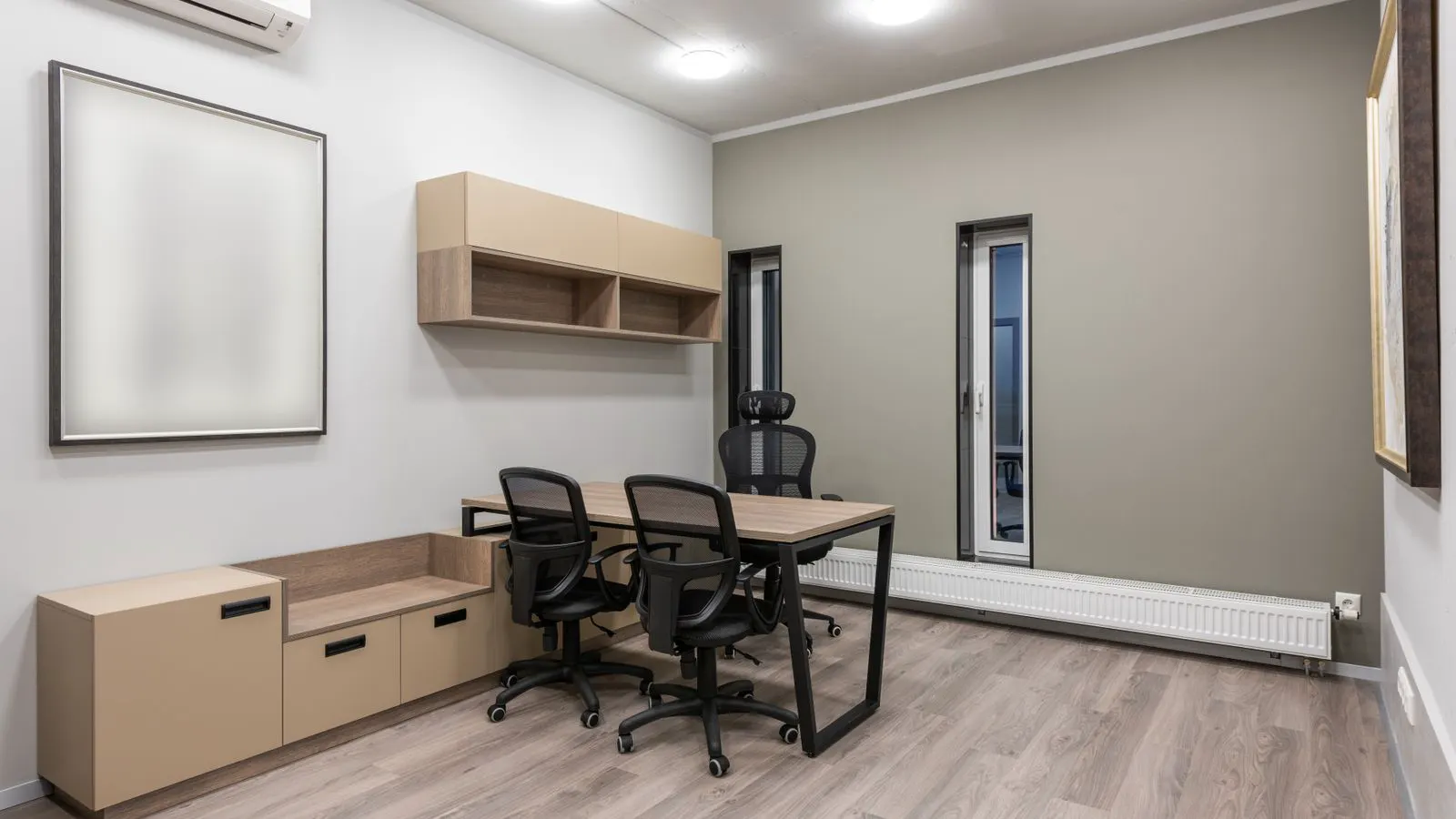
Use this office furniture checklist to verify dimensions, materials, and compliance before signing purchase orders. It covers workstation specs, chair ergonomics, and documentation needed to avoid costly errors and ensure the equipment fits your team and facility.
- Confirm physical dimensions, materials, and weight limits before approving any order.
- Verify that task chairs and desks meet your team's ergonomic and accessibility requirements.
- Check for required documentation, including material declarations, warranty terms, and compliance certificates.
- Review assembly and logistics details to prevent delays and site damage.
Verify Core Dimensions and Site Fit
Measure every workstation location before sending a purchase order to a supplier. A desk that fits the showroom may not fit the corner of the main floor. Record width, depth, height, and any required clearance for drawers or cable management. Check the ceiling height if using standing desks with overhead panels or monitor arms.
Check the doorways and elevators. A 1600 mm wide desk may fit in a bay but not pass through a standard hallway. If the furniture is delivered in flat packs, measure the package dimensions. If it arrives assembled, measure the full unit. Include a 100 mm buffer for the delivery team to maneuver the load.
Red flag to watch: A supplier’s catalog lists a desk depth of 800 mm but the product name implies a deep work surface. Verify the actual drawing. If the drawing is missing, request it before approving the order.
Confirm Furniture Specifications and Materials
The furniture specifications sheet is your primary defense against receiving the wrong product. Do not rely on the salesperson’s verbal description. Get the written spec sheet for each item.
For desks, check the top material, edge banding, and leg structure. A laminate top with a particleboard core is different from a solid wood top. The load capacity for the top and the drawers matters. A drawer that holds 20 kg is not the same as one that holds 40 kg. Check the finish color under standard lighting. Some colors look different in the warehouse than they do on the floor.
For chairs, check the base material and the gas cylinder. A steel base is different from a plastic base. Check the seat depth and the backrest height. Verify that the chair has the required height adjustment range for your staff.
Red flag to watch: The spec sheet lists a “standard” finish without a color code. Ask for the Pantone or RAL code. If the supplier cannot provide it, the finish is a guess.
Check Ergonomic and Accessibility Requirements
Not every chair is a task chair. A standard office chair may have a fixed armrest height and a limited seat depth. A task chair is designed to be adjusted for a range of users. If your team includes people of varying heights, a single standard chair model will not work for everyone.
Check the seat height range. A chair that adjusts from 400 mm to 500 mm will not fit a person who needs 350 mm. Check the armrests. Do they move up and down? Do they pivot? If the user has a disability, check if the chair meets your local accessibility standards.
For desks, check the sit-stand height range. If you are buying sit-stand desks, verify the motor speed and the weight capacity. A desk that supports 150 kg is different from one that supports 300 kg. Check if the desk has a cable tray or a grommet hole. Without one, your team will have to buy add-on accessories.
Red flag to watch: The product description says “ergonomic” but the spec sheet does not list the adjustment points. If it is not listed, it is not there. Ask the supplier to provide a diagram showing the adjustment range.
Review Compliance, Safety, and Documentation
Before the goods ship, collect the documentation. This is where many procurement errors happen. A chair that looks fine may fail a safety test if the gas cylinder is not certified. A desk that looks fine may have a chemical issue if the finish is not declared.
Ask for the material declaration. This document lists the components of the product and their origin. It is needed for environmental compliance and for internal sustainability reports. Ask for the safety certification. This proves the product passed the required tests for the market you are buying into.
Check the warranty terms. A two-year warranty on a chair is standard. A five-year warranty on a desk is common. But the terms matter. Does the warranty cover the gas cylinder? Does it cover the laminate top? What happens if the product fails after three years? Read the exclusions. A warranty that excludes “normal wear and tear” is not a warranty.
Red flag to watch: The supplier sends a generic warranty document for all products. This is a sign that they are not tracking the specific batch. Ask for a certificate of conformity for your specific order number.
Assess Assembly, Logistics, and Return Policy
Flat pack furniture is cheaper to ship but harder to assemble. Assembled furniture is easier to install but harder to ship. Decide which method fits your site. If you are using flat packs, check the assembly time. Some desks take 15 minutes. Others take 45. If you are installing 50 desks on one day, you need a plan.
Check the delivery terms. Who is responsible for the last mile? If the supplier delivers to the dock, your team unloads it. If the supplier delivers to the floor, the supplier unloads it. This changes the cost. Check the return policy. If a chair arrives with a broken armrest, who pays for the return shipping?
Check the spare parts policy. If a gas cylinder fails in three years, can you buy a replacement? If the supplier does not sell spare parts, you are locked into buying a new chair. Ask for a list of replaceable parts.
Red flag to watch: The supplier quotes a price that is significantly lower than the market average. Check the assembly and return terms. A low price often hides a high cost in delivery or after-sales support.
Sample Specification Table
| Item | Specification | Check |
|---|---|---|
| Desk Top | Laminate, 25 mm thick, 1200 x 800 mm | Load capacity 150 kg |
| Desk Base | Steel, powder coated, adjustable height | Motor speed 120 mm/s |
| Task Chair | Mesh back, adjustable armrests, 4-star base | Seat height 400-520 mm |
| Cable Management | Integrated tray, 2 grommet holes | Weight limit 10 kg |
| Finish | Matte, RAL 9016 | No gloss variation |
Final Review and Approval
Before signing the order, run the checklist through your team. Give the spec sheet to your facilities manager. Give the ergonomic data to your HR team. Give the warranty terms to your finance team. If one team says “no,” the order is not ready.
Do not sign the order until the supplier confirms the lead time in writing. A lead time of “four weeks” is not a promise. A lead time of “four weeks from receipt of payment” is a promise. Check the payment terms. Net 30 is standard. Net 60 is common. But a deposit requirement of 50% is a risk.
Keep a copy of the checklist and the approved spec sheet in your procurement file. If a dispute arises, this file is your evidence. The supplier will not remember what they promised. You will.
The office furniture checklist is not a formality. It is a tool. Use it to protect your budget, your team, and your facility. A good order is built before the goods arrive.
Frequently asked questions
What is the most common error in office furniture procurement?
Ordering based on a catalog image instead of a written specification sheet. This leads to incorrect finishes, dimensions, or features.
How do I verify the ergonomic fit of a task chair?
Check the seat height range, armrest adjustability, and backrest support in the spec sheet. If the range does not match your staff's heights, the chair will not fit.
What documents should I request before finalizing an order?
Request the material declaration, safety certification, warranty terms, and a certificate of conformity for your specific order number.
Is flat pack furniture always cheaper than assembled furniture?
Flat pack furniture is usually cheaper to ship but may cost more in labor and time. Assembled furniture is easier to install but more expensive to transport.
How long should I keep my procurement checklist?
Keep it for the full warranty period of the product. If you need to claim a warranty or dispute a defect, the checklist is your reference.